
Electric Vehicle Implementation Resources for Commercial Fleets
Three areas of information and tools to help streamline electrification for fleet owners

I’m back and charged up after a winter holiday hiatus ⚡🎄. Today we’ll dive into some actionable steps for fleet owners to take when planning for EV trucking operations in 2024.
Commercial fleet operators are currently navigating a complex and rapidly changing environment in the trucking electrification space. Federal and state incentives, mandates, new policies, and individual fleet needs all can impact operations and transition planning. There has been a lot of work done to help fleet owners with this transition, and this post will share some of those resources.
Alternative Fuel Data Center - Fleet Electric Vehicle Implementation Checklist
Part of the Department of Energy, the Alternative Fuel Data Center (AFDC) “provides information, data, and tools to help fleets and other transportation decision makers find ways to reach their energy and economic goals through the use of alternative and renewable fuels, advanced vehicles, and other fuel-saving measures.”
The AFDC put together a one-page checklist for fleet owners preparing to electrify their fleets. You can download that checklist below, or can navigate to their site here.

The checklist breaks down to-do items into two sections, Selecting Vehicles and Installing Infrastructure. The first three tasks in Selecting Vehicles all can be completed without external coordination. These steps are:
assessing fleet routes and truck requirements
exploring incentives or mandates at a local, state and federal level
forming a budget and planning project costs
With those steps complete fleet owners can begin coordination with other parties. External coordination includes:
determining available EV inventory
conducting site planning with utilities
developing a project plan with vehicle providers, charging equipment vendors, the utility, contractors, etc.
and more…
Over 30 different tasks throughout the lifecycle of adding EVs to a new fleet are highlighted. The checklist is geared toward initial planning and implementation, and thus it does not offer post-implementation or ongoing operations guidance. It is still, however, a great self-driven resource for any fleet owner upgrading to EV trucks.
Utility Driven Planning and Electrification Support
Utility companies have a strong incentive to help guide customers through fleet electrification projects. Transportation electrification represents a massive change for utilities and a significant increase in demand over the next several decades. Utilities who can effectively plan with commercial and industrial customers and make the transition easier stand to benefit over other electricity providers.
Nearly every major utility company, including NextEra, PG&E, SoCal Edison, National Grid, conEdison, Florida Power & Light, Georgia Power, Dominion Energy, DTE Energy, and many more all have dedicated resources and support available for fleet owners to start their electrification journey. The links above send customers to dedicated landing pages with instructions for coordination with the utility on fleet electrification projects.
Early identification of charging and fleet needs help utilities plan future upgrades and coordinate across multiple customers for infrastructure upgrades. There are also opportunities to share or reduce “make-ready” charges, which are costs associated with updating utility infrastructure to accommodate EV charging at your site.
Additional Public and Government Resources
Many different parts of the government have published information and resources to aid fleet owners in delivering electric vehicle upgrades and charging site deployment. The National Renewable Energy Laboratory (NREL) is working on several avenues of commercial fleet electrification. One such effort below outlines the public facing layout of a travel center upgraded for electric vehicles, including both kilowatt-scale and megawatt-scale charging infrastructure.
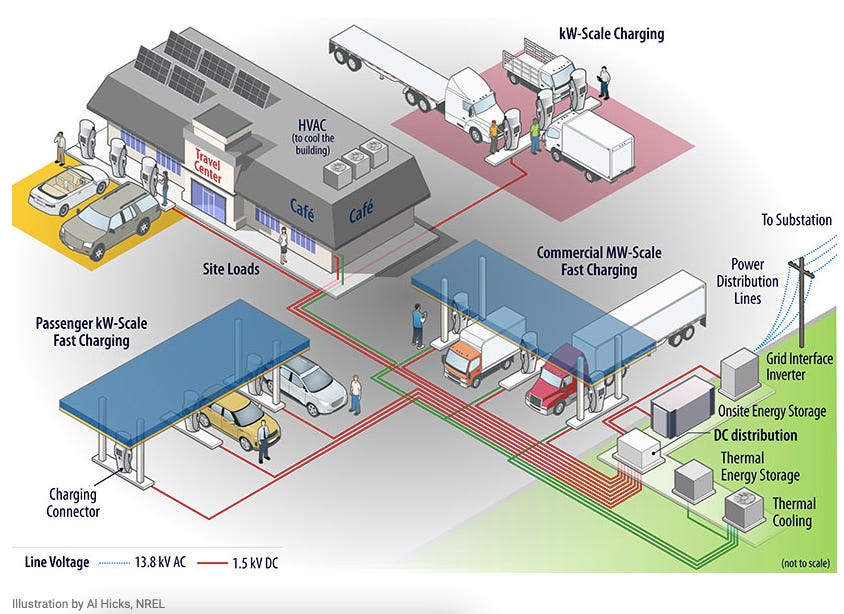
NREL is collaborating with industry on electric vehicle charging standards, defining technical specifications to support charging capacity up to 3.75 MW. This charging capacity, around 7 times today’s 500kW DC fast charging capabilities, is necessary for speedy recharging for the large battery packs required in commercial class 8 trucks.
NREL also offers site planning and design support, stating on their website they can “help assess en-route charging, as well as associated planning, infrastructure, operation, and maintenance options, for on-road and non-road vehicles, aviation, rail, and marine applications.” Taking advantage of the simulation and modeling capabilities of the NREL researchers when assessing your EV fleet could be beneficial during planning.
In addition to their useful EV Implementation Checklist, the AFDC also has resources for companies procuring and installing charging infrastructure. Here they share dozens of resources including multiple case studies, planning tools, maps, and other considerations for fleet owners and EV charging operators.
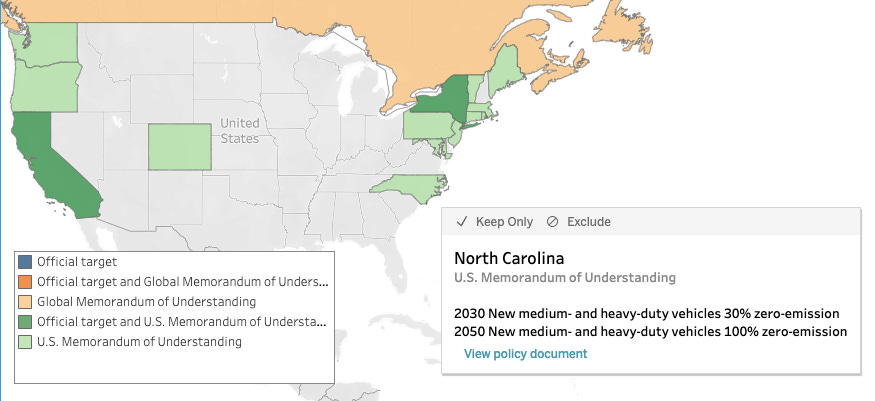
On the mandates and regulation side, the International Council on Clean Transportation (ICCT) has developed a global view of current policy related to electrification of heavy duty vehicles. The interactive map shows current country and state-level policies that call for certain phase-out targets and timelines. This is useful to understand the patchwork of state regulations and plan for appropriate adoption in advance of regulations.
Conclusion
The transition to electric commercial fleets is a critical step toward a sustainable future, requiring more than just adherence to mandates or leveraging incentives. It demands active engagement with evolving technologies, infrastructure development, and regulatory changes.
Utilizing resources from the Alternative Fuel Data Center, utility companies, and the National Renewable Energy Laboratory will help fleet owners navigate the messy middle of fleet electrification, saving time, money, and reducing complexity.