
EV Charging Adoption Programs and Incentives in the Seattle Area
Utility, State and National Programs Available to Individuals and Businesses for Installing Level 2 and DCFC EV Charging Hardware

In today’s article we will dig into the incentives/rebates available to individuals and commercial entities in the Seattle area for the installation of EV charging equipment. I am based here in Seattle, so I had a lot of fun exploring the policy and program landscape for EV charging close to home. I’ll share details about each program along with additional resources for further exploration.
There is a significant push locally, regionally, and nationally to electrify passenger and commercial transportation. Large amounts of government and private capital are flowing into electrification efforts and the infrastructure upgrades required to support the coming boom in EV transportation. A business or individual can craft an optimal electrification strategy by fully understanding and effectively utilizing the available policies supporting their transition. Let’s start at the local level.
Seattle City Light Programs
Seattle had 29,000 registered passenger EVs as of March 2024, representing about 6% of the roughly 460,000 total registered cars in Seattle. To support those drivers and to help companies electrifying their fleets, Seattle City Light has two available programs for businesses and individuals when installing EV charging hardware.
First is the Midstream Residential EV Charger Program, a pass-through rebate of up to $400 on Level 2 charging for individuals with properties that have only one-to-four dwelling units. There are several requirements, including a max power rating of 11.6kW or less for the charger, a set list of products to choose from, and a requirement to contract with participating distributors. The program runs through December 31st, 2024, and can reduce the cost of a Level 2 charger by up to half in the example shared on the Seattle City Light website.
The second is a comprehensive commercial incentive program called the Fleet Electrification Program. The program has three parts, the On-Road Vehicle Charger Rebate, the Non-Road Equipment Infrastructure Rebate, and the Make-Ready Infrastructure Incentive.
On-Road Vehicle Charger Rebate
From Seattle City Light, here is a summary of the details found on their website:
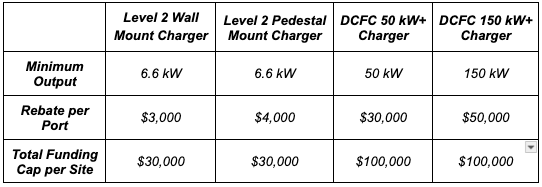
On-Road Vehicle Charger Rebates offer financial assistance for EV charger hardware and installation costs.
Non-Road Equipment Infrastructure Rebate
Again, from the Seattle City Light program website:
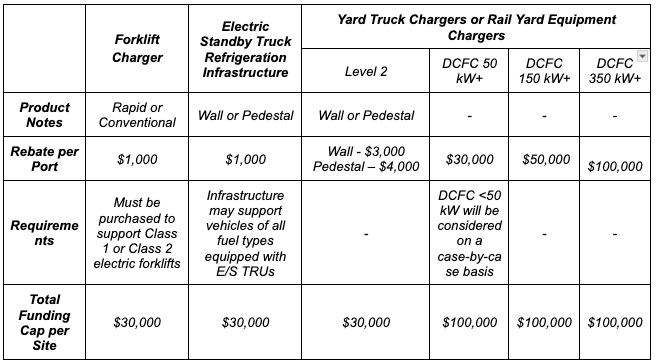
Non-Road Equipment Infrastructure Rebates offer financial assistance for non-road electric technology chargers and infrastructure, including electric forklifts, yard trucks, rail yard equipment, and truck refrigeration unit infrastructure.
Make-Ready Infrastructure Incentive
Make-ready infrastructure refers to the foundational electrical work and physical preparations required to install EV charging stations. This includes the installation of conduit, wiring, electrical panels, and any necessary transformers, as well as upgrades to existing electrical systems to handle the added load of EV charging.
Unfortunately, this part of the Fleet Electrification Program is not currently active. Here’s the latest from SCL:
This Make-Ready incentive is currently on hold as we reevaluate program details and explore the potential impact of Washington’s new Clean Fuel Standard. We are not accepting new applications at this time. We will be relaunching the incentive later this year.
The Make-Ready incentive previously covered:
any utility-owned infrastructure and equipment that provides electric services, extensions, or upgrades needed to support the installation of EV infrastructure in excess of standard new business allowances and any customer-owned equipment from the point of interconnection up to (but not including) the charging equipment.
Seattle City Light also includes the following disclaimer on the program overall:
Incentives are not to exceed 50% of total charger and installation costs or the per-port incentive cap, whichever is lower. In addition to per-site incentive caps, customers are capped at $200,000 in total On-Road and Non-Road rebates per program year.
Even with only up to 50% matching, this program delivers a significant boost to project economics for commercial entities looking to upgrade their on-site electric charging infrastructure.
Puget Sound Energy
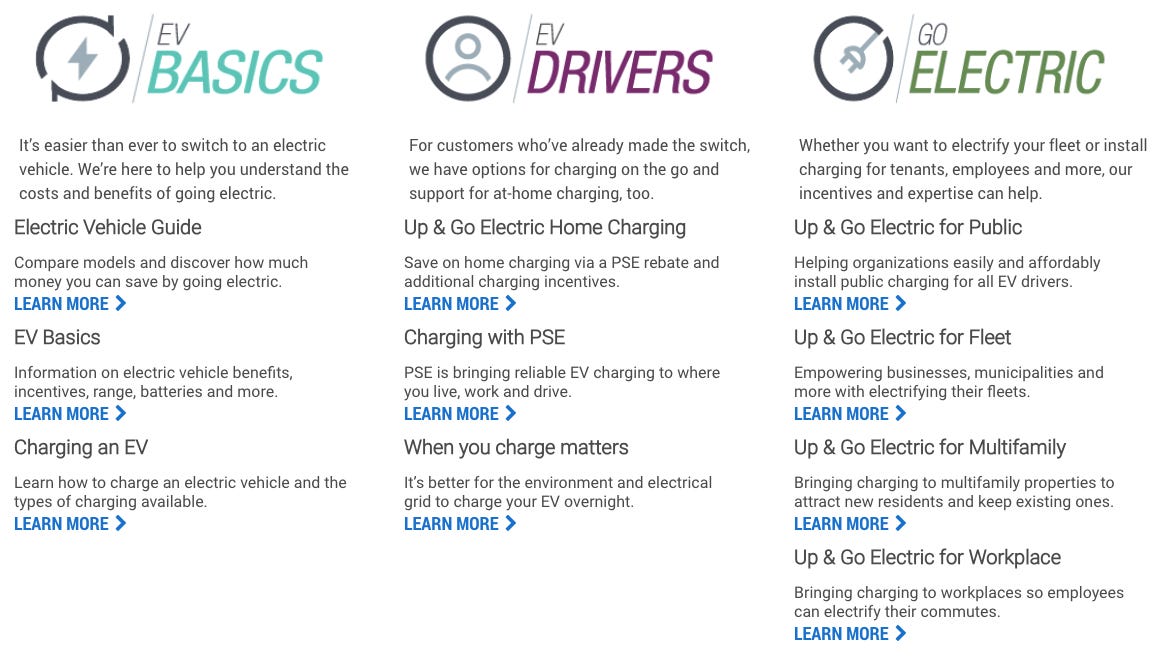
For those in the surrounding Seattle area, Puget Sound Energy offers quite a few options for residential EV charging incentives and benefits. Here is a screenshot from their electric car homepage on the types of services they offer. We’ll dive into several below.
Residential Programs
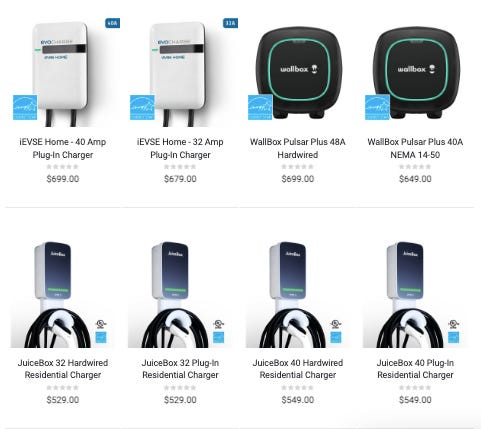
First is their blanket incentive on Level 2 chargers, a $300 rebate. This can be applied when purchasing from their PSE Marketplace, which includes brands like EnelX, EVoCharge, and Wallbox as well as both hardwired and plug in charger types. This can also be applied after purchase of qualifying chargers with submission of a form on the program website here.
They also share that purchasing a charger through the marketplace will automatically apply the rebate, and will automatically enroll the customer in the PSE Flex EV program. The Flex EV program is a demand-response program to shed EV charging load during peak grid events. PSE will pay customers a $100 signup bonus and $0.50 for every kWh saved during a “Flex event”, which they define as a period of heightened demand for electricity, usually in the summer or winter months. The program is coordinated by Autogrid, a company focused on distributed energy resource management systems and integrations with utilities.
PSE also has resources and recommendations in finding a contractor for installation and a program called Empower Mobility aimed at supporting low-income customers in their electrification needs. PSE offers customers whose household size and income qualify the following benefits:
A $600 rebate – double the standard rebate – when purchasing a Level 2 charger.
Up to 100 percent or $2,000 of the installation costs for your Level 2 charger, potentially including any extended warranty or maintenance packages.
The $600 rebate fully covers 2/3rd of the chargers on the PSE Marketplace, and fully covering installation cost up to $2,000 in most cases will mean no out of pocket expenses for a Level 2 upgrade in your home. PSE has a table by county and household size to determine if your monthly income level qualifies for the program.
Commercial Programs
There are four main programs from PSE for commercial entities installing EV charging equipment. We will go through each one below, but first I’ll explain some structures that repeat across all the programs. PSE is offering incentive programs with two purchase options, either PSE-owned systems or customer-owned systems. PSE-owned systems come with turn-key installation services and higher incentive/rebate maximums, while customer-owned systems give choice in hardware and long-term ownership but have lower incentives.
Additionally, in each program there are increased incentives for Empower Mobility designated projects, or those located in disadvantaged and underrepresented communities. Specifics vary, but in many cases the incentives double, or costs are fully covered if your site qualifies. PSE is very interested in helping to shape the coming electrification of Western Washington’s EV charging landscape in an equitable way. Sites located in communities with high Environmental Health Disparities, sites located in native or tribal territory, and sites serving vulnerable populations all qualify for the Empower Mobility program benefits.
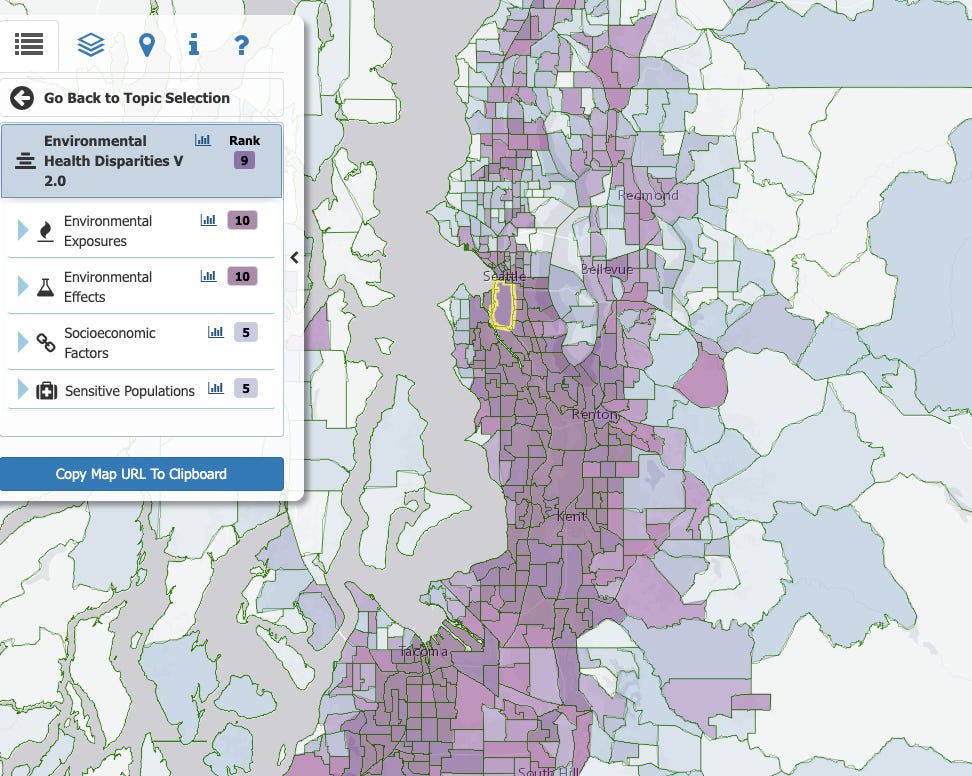
Booming EV adoption is an incredible load growth opportunity for the utility, and PSE wants to both aid in/benefit from the transition and also wants to bring marginalized and underserved communities extra support. Let’s dive into the programs they are using to shape commercial action.
Public Charging Program
PSE is willing to help fund the buildout of Level 2 and Level 3 public charging infrastructure with their Public Charging Program. Here are the basic details of the options available to businesses, from the PSE website:
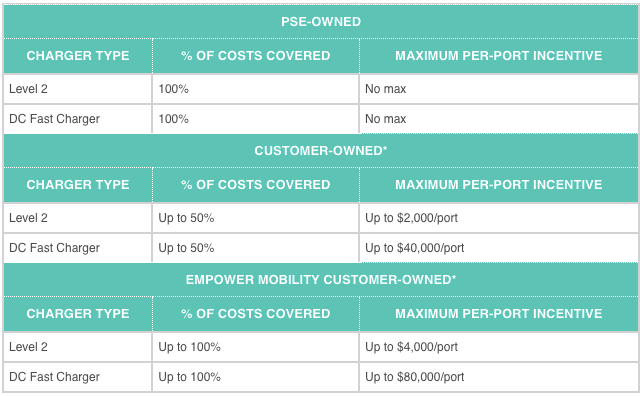
For a company choosing the PSE-owned route, they must:
Agree to a 10-year minimum lease agreement with PSE.
Agree to an easement agreement with PSE
Verify the property is free of existing option agreements that would otherwise preclude its development by another party.
And for the customer-owned program, the business must:
Install a separate, dedicated meter for the charging station.
Meet standards, equipment and metering requirements, such as mounted signage, available payment methods, registration and reporting.
Ensure the site is able to serve multiple vehicle makes.
Agree to a non-negotiable service agreement.
The customer-owned options have an incentive limit of $250,000 per project. Additional allowances for service line and transformer upgrade costs up to $20,000 per DC fast charger port and $2,000 per Level 2 port.
Here are the next steps if you want to move forward for each program from PSE:
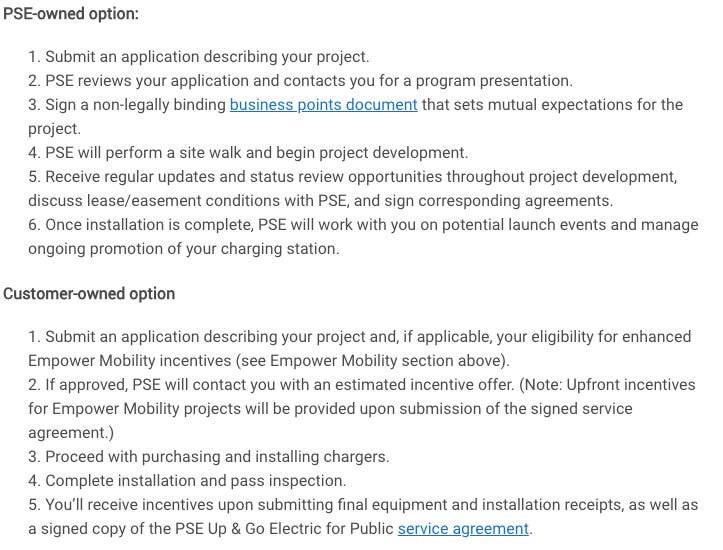
The main decision comes down to whether or not the business wants to own the chargers and all the benefits and responsibilities that come with it. The business will have to pay for installation, operations, and maintenance of the chargers for the useful life, including the cost of the electricity vended to EV drivers, but they do receive the tax benefits and the Washington state Clean Fuel Standard credits from the stations use.
Fleet Charging Program
PSE will work directly with businesses on fleet electrification projects, both for PSE-owned and for customer-owned charging stations. Here are the incentives available:
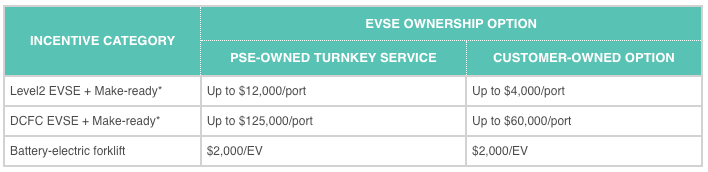
If you qualify for the Empower Mobility program (see above) the incentives expand to light-, medium-, and heavy-duty vehicles.
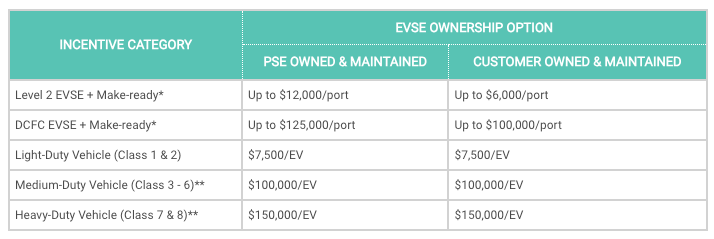
*Total maximum incentive of $250,000 per charging location; customer pays make-ready infrastructure upgrade fees above maximum allowance
**EV incentive for medium & heavy duty up to 50% of incremental cost of equivalent ICE vehicle
When assessing applications for the Empower Mobility program, PSE will evaluate submissions based on the following criteria:
Community impact: How and to what magnitude will the project benefit and serve low-income tenants, Tribal communities and/or other named communities?
Geographic diversity: Does the project increase access to electric vehicle charging in areas underserved by EV charging infrastructure? Has PSE already provided funding for EV charging infrastructure in this area?
Use case: Will the project increase EV charging availability at a wider range of fleet types in PSE’s service area?
Utilization: What is the likelihood of EV charging being used at the proposed property based on the number of EVs within the fleet and existing EV charging options at the property?
Fleet electrification is an exciting overlap of two of my passions. I love to see that PSE is prioritizing both passenger and fleet electrification and that their Empower Mobility program funnels more of the funds to disadvantaged communities, as DACs have borne the brunt of the pollution and damage from ICE vehicles.
Multifamily Charging Program
PSE is also committed to expanding access to EV charging at multifamily residential properties. Access to level 2 charging in multifamily housing is a big barrier to wider EV adoption. Providing Level 2 charging opportunities at home both raises the value of the property and enables drivers to turn to an EV for their next purchase/lease. Here are the program specifics for the two types of ownership options:
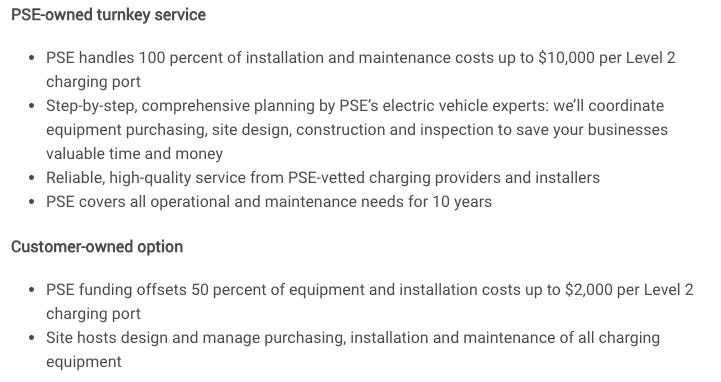
A multifamily residential property owner participating in the program must own/manage a property with five or more units, must agree to promote the availability of electric charging to its residents, and most interestingly must agree to not charge tenants above the cost of electricity used for charging, among other things. I appreciate the requirement to charge a fair rate for the electricity delivered, especially if PSE is footing some of the bill to build out the chargers in the first place.
Workplace Charging Program
The last program in PSE’s commercial arsenal is the workplace charging program. Participating businesses can choose from the PSE-owned or customer-owned route for their Level 2 charging equipment installed at their workplace. The PSE-owned option covers 100% of installation and maintenance costs up to $12K per port and up to 10 ports per property. The customer-owned option offsets 50% of equipment and installation costs up to $2K per port and 10 ports as well. The customer-owned option doubles to 100% and $4K for those serving highly impacted communities and vulnerable populations.
The eligibility guidelines are fairly broad:
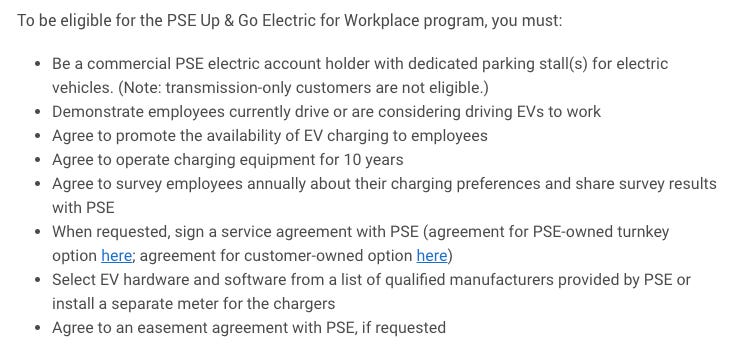
The formula for success for interested workplaces will be crafting a compelling application on the charging needs and preferences of their employees.
Washington State Programs
At the state level there are a couple of programs promoting EV charging that I will highlight. First applies to everyone in Washington purchasing EV charging hardware. The Department of Revenue has instituted a sales and use tax exemption on the sale of EV charging infrastructure and hardware. The qualifying activity and reporting requirements are included here:
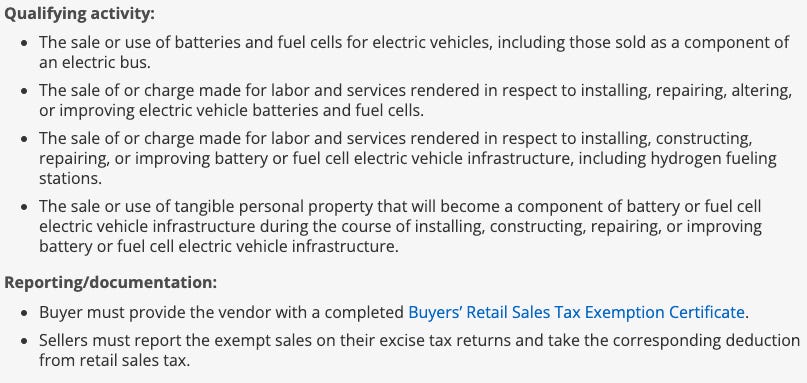
The second program I’ll highlight is from the Washington Department of Commerce, called the Washington State Electric Vehicle Charging Program. With over $64M in available awards, the WAEVCP aims to “reduce emissions, improve air quality and promote equitable access to electric vehicle charging infrastructure.” To accomplish this goal the program aims to fund at least 200 DC fast charging ports and 2,000 Level 2 charging ports in a variety of communities. They state that “At the heart of our program is a strong focus on environmental justice. We believe in achieving the highest environmental quality and health outcomes for all, while targeting investments in communities that have been disproportionately impacted by pollution and need assistance installing EV infrastructure.”
The program has broken out additional concrete goals, outlined here:
Fund a variety of projects including:
Urban, suburban, rural and tribal communities
Multifamily housing developments
Locations that fill gaps in the current EV charging station network
Workplaces and fleet depots
Equitably divide available funds, by allocating funds as follows:
45% of funds ($28.8 million) are dedicated for Level 2 chargers at multifamily housing (defined as at least 5 units)
40% of funds ($25.6 million) are dedicated for Level 2 chargers or DCFC units at publicly available sites
15% of funds ($9.6 million) are dedicated for Level 2 chargers at fleet depots or workplaces
Ensure at least 10% of funding awarded/ports installed to projects led by/partnered with tribal governments or entities and located on tribal lands
Average project completion time is 250 days for Level 2 chargers and 550 days for Level 3 chargers
Support labor and workforce development by promoting the adoption of project labor agreements for the installation labor and encouraging the training/education of electrician apprentices on program-funded EV charging stations
The first round of award winners have already been identified, and I'm excited to follow along with the new stations opening up over the next couple years.
National Programs
Finally at the national level there are additional incentive programs to utilize.
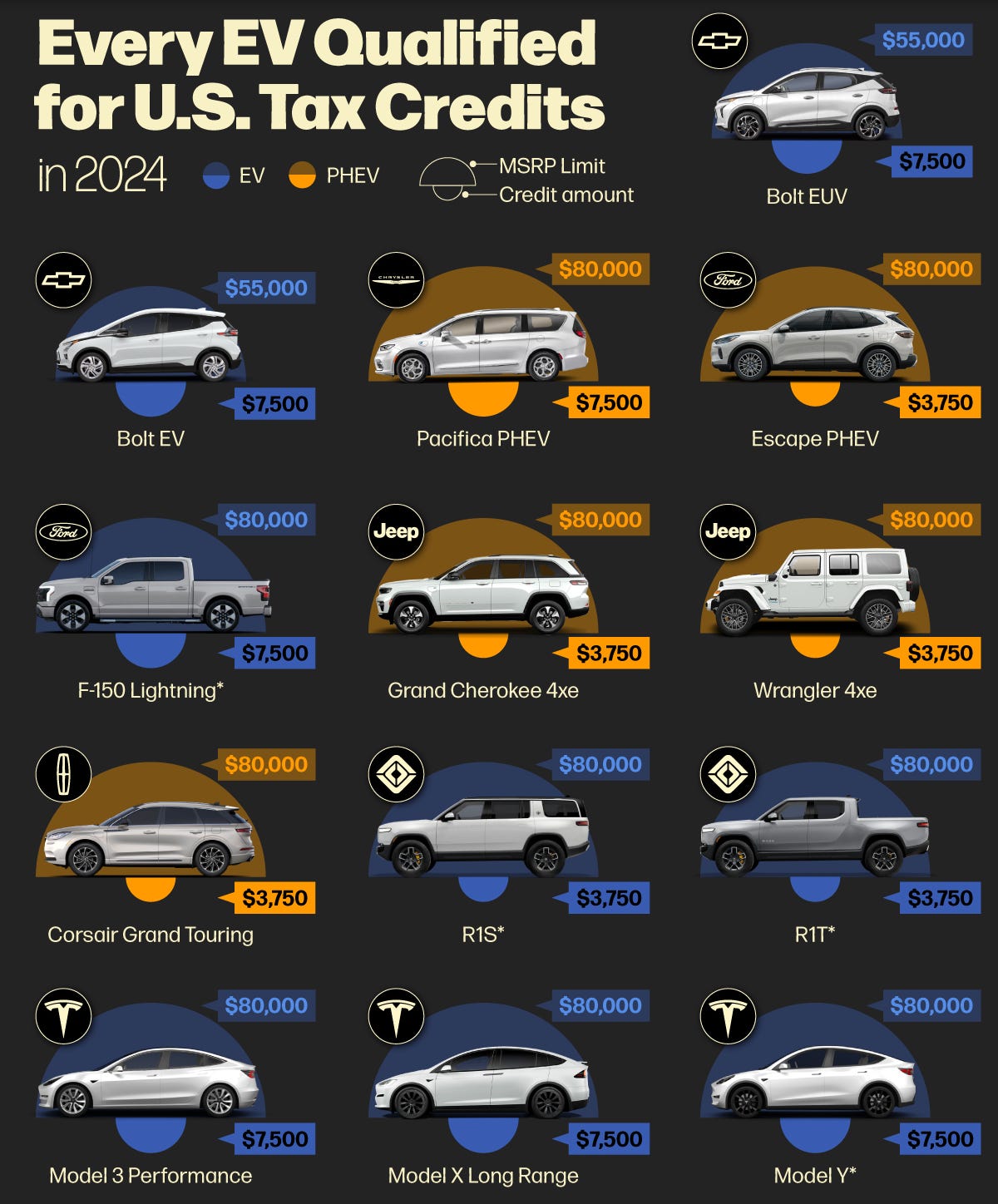
For individuals there is the EV rebate of $7,500 for certain cars at time of purchase, as well as some OEM programs to provide an equivalent rebate. There is also a rebate for purchase of a qualified used EV of $4,000. The Visual Capitalist has put together a great infographic on the 2024 eligible models, found below:
On the charging side there is both a business and individual tax credit for installation of EV charging equipment. For residential charging you receive a credit up to $1,000 for 30% of the costs of installing a Level 2 charger. You can use Form 8911 to file this type of personal tax credit.
For businesses the same 30% tax credit applies only if prevailing wage and labor laws are met, otherwise it is a 6% credit. The 5x increase in the tax credit is a strong incentive for these projects to follow the requirements, including apprenticeship and proper reporting. Businesses can deduct up to $100,000 in hardware and installation costs, increased from $30,000 before 2023 and changed with the Inflation Reduction Act passage.
Conclusion
There are a significant number of incentive programs available to residents and businesses in the greater Seattle area. Utility programs are offering some incentives for individuals but a much wider array of options for business and commercial entities. State and national programs are available for after the fact rebates and up to full funding support for larger commercial projects.
Relatively high EV adoption rates in Washington and the greater Seattle area compared to other parts of the country are spurring focus and investment in EV charging infrastructure. Axios reports that:
Washington saw the biggest increase in EV market share in 2023 of any state… a 43% jump – from 118,050 in January 2023 to 168,850
As more drivers switch to electric vehicles we need to make sure that accessible, reliable, and convenient charging stations are available for use across home, workplace, and public settings. Programs like the ones outlined here will be crucial in spurring the investment in charging infrastructure necessary to support these new EVs hitting the road at a rapidly increasing pace.
Thanks for reading, I hope that you’ve found this information useful or at least interesting to learn! Let me know if you have any questions or comments, I enjoy hearing from you.